Every successful business follows a journey before it receives national recognition. It starts with building trust, strengthening a brand, expanding its reach, and consistently delivering value ...

07Aug

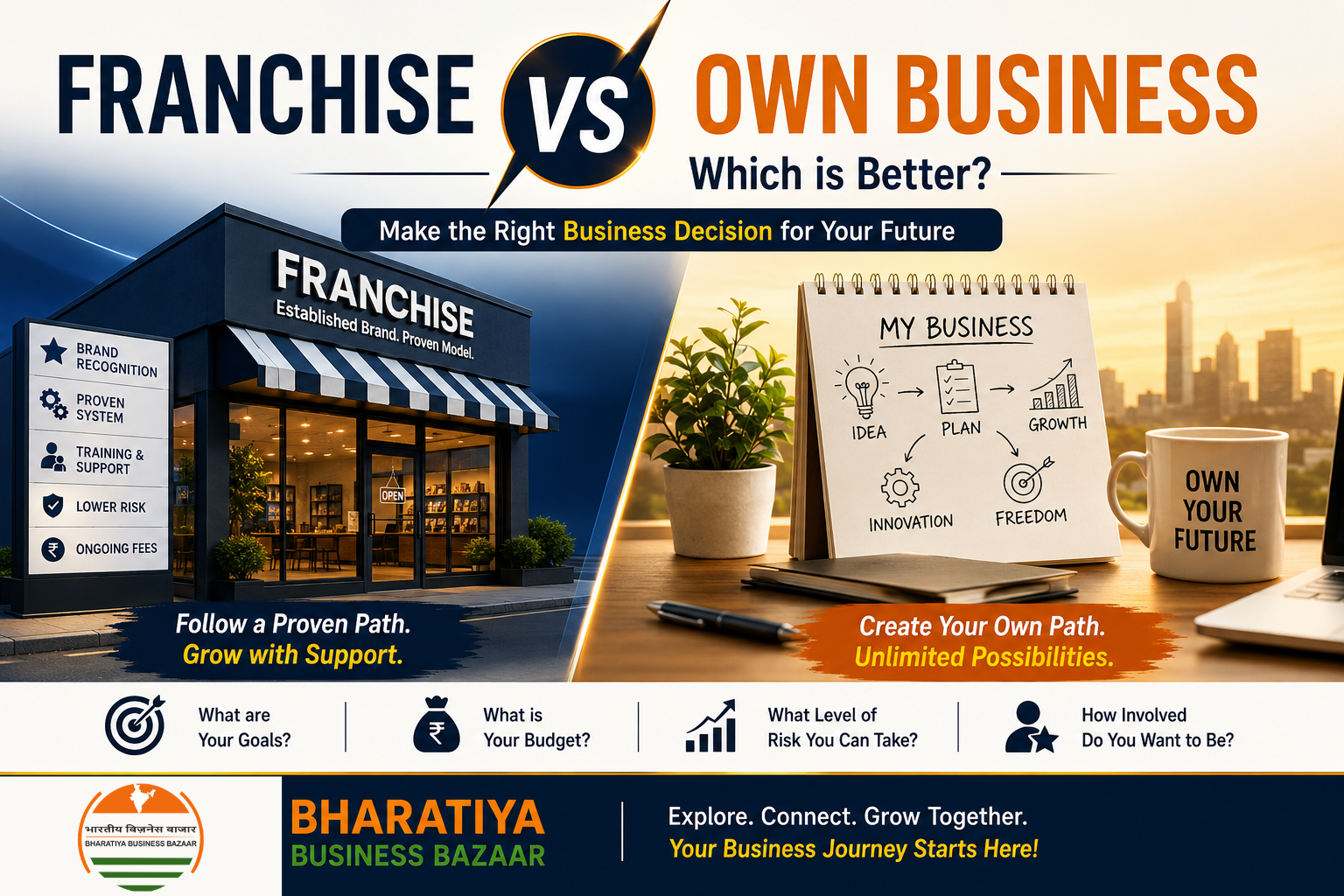
Starting a business is one of the most significant financial and career decisions a person can make. While many aspiring entrepreneurs dream of building a successful company, one question often creates confusion before they begin their journey: Should I buy a franchise or start my own business?
Both options have helped thousands of entrepreneurs achieve success, yet they follow completely different paths. A franchise allows you to operate under an established brand with a proven business model, while starting your own business gives you complete freedom to create, innovate, and build a brand from scratch. Neither option is universally better—the right choice depends on your financial resources, experience, risk tolerance, long-term goals, and entrepreneurial mindset.
In recent years, India has witnessed remarkable growth in both franchising and startups. From food chains and retail stores to digital agencies and manufacturing businesses, entrepreneurs now have more opportunities than ever before. This abundance of options has also made the business decision more challenging. Understanding the strengths and limitations of each model is essential before investing your time and money.
This guide explores the key differences between a franchise vs own business, helping you evaluate which option aligns with your ambitions. Whether you’re a first-time entrepreneur or someone planning your next venture, this article will help you make an informed decision.
A franchise is a business arrangement where an entrepreneur purchases the rights to operate under an established company’s brand name and business model. Instead of building everything from the ground up, the franchise owner follows systems, processes, and operational guidelines developed by the parent company.
When you invest in a franchise, you are buying more than just a business name. You gain access to an existing reputation, operational training, marketing support, standardized products or services, and proven business strategies. Customers already recognize the brand, making it easier to attract business from day one.
However, this convenience comes with certain limitations. Franchise owners must follow company policies, maintain brand standards, and often pay ongoing royalty fees. While the risk of failure may be lower compared to launching a completely new business, entrepreneurs sacrifice a significant degree of independence.
Starting your own business means creating something entirely from your own ideas, experience, and vision. You choose your business name, develop your products or services, define your pricing strategy, build your marketing campaigns, and create your own identity in the market.
Unlike a franchise, there are no fixed operational guidelines. Every decision—from branding and customer experience to expansion and innovation—is entirely yours.
Building a business from scratch requires patience and persistence because customers may not immediately trust a new brand. Establishing credibility takes time, and entrepreneurs often face challenges in attracting their first customers. However, the greatest advantage is complete ownership. Every improvement you make directly increases the value of your own brand rather than someone else’s.
Many of India’s largest companies began as small independent businesses. Their founders accepted higher initial risks in exchange for unlimited future growth opportunities.
The biggest difference between these two business models lies in ownership and control.
A franchise provides structure, guidance, and an established customer base, making it ideal for individuals who prefer following proven systems. On the other hand, an independent business offers complete flexibility, allowing entrepreneurs to experiment, innovate, and build something truly unique.
Financially, franchises usually require higher initial investments because entrepreneurs must pay franchise fees, security deposits, infrastructure costs, and recurring royalty payments. Independent businesses can often be started with much smaller investments, especially if they are service-based or digital businesses.
Marketing also differs significantly. Franchise owners benefit from national advertising campaigns and established brand recognition. Independent business owners must create their own marketing strategies, build customer trust, and develop their reputation from scratch.
Growth opportunities are another important consideration. Franchise expansion is often controlled by the parent company, whereas independent business owners have complete freedom to diversify products, expand into new markets, introduce new services, or even franchise their own brand in the future.
Ultimately, the startup vs franchise debate revolves around one question: Do you prefer security with limited freedom, or freedom with greater responsibility?
For many first-time entrepreneurs, purchasing a franchise can reduce uncertainty. If you have sufficient capital but limited business experience, operating under an established brand provides confidence and guidance during the initial years.
Franchises are particularly attractive for industries where brand recognition heavily influences customer decisions, such as food chains, education centers, fitness studios, salons, retail stores, and healthcare services.
Training provided by franchisors often includes operations, staff management, marketing, inventory control, customer service, and technology systems. This support significantly reduces the learning curve for new entrepreneurs.
However, prospective franchise owners should carefully evaluate royalty fees, contract duration, territorial restrictions, renewal conditions, and exit clauses before making any investment.
Entrepreneurs with strong ideas, creativity, and long-term ambitions often find greater satisfaction in building their own businesses.
If you possess specialized skills, industry experience, or innovative solutions to customer problems, creating your own brand allows you to fully capitalize on your expertise. Every improvement you make contributes directly to your company’s reputation and valuation.
Starting independently also gives entrepreneurs complete pricing flexibility. You can introduce new products, modify services, experiment with marketing campaigns, or pivot your business whenever market conditions change.
Although the initial journey may involve greater uncertainty, successful independent businesses often generate significantly higher long-term returns because owners retain complete ownership of profits, intellectual property, and brand equity.
Money plays an important role in choosing between a franchise and an independent business, but it should never be the only deciding factor.
Franchises usually require upfront franchise fees, interior setup costs, equipment purchases, licensing expenses, and ongoing royalty payments based on monthly revenue. While these costs may appear substantial, entrepreneurs receive a proven operational system in return.
Independent businesses generally offer greater flexibility regarding investment. Some service-based businesses can begin with minimal capital, while manufacturing or retail ventures may require larger budgets. The absence of royalty payments allows business owners to retain all profits, but they must independently manage branding, customer acquisition, and operational development.
Carefully calculating startup costs, projected revenue, operating expenses, and expected return on investment can help entrepreneurs make a financially sound decision.
Every business carries risk, regardless of the model you choose.
Franchises reduce operational uncertainty because systems have already been tested in multiple locations. However, franchise owners remain dependent on the reputation and decisions of the parent company. A negative incident affecting the brand nationally can impact every franchise location.
Independent businesses involve greater early-stage uncertainty because entrepreneurs must build trust, establish operations, and attract customers independently. However, successful businesses enjoy unlimited scalability and complete ownership.
The willingness to accept short-term uncertainty often determines long-term rewards.
Whether you choose to purchase a franchise or launch your own company, visibility is essential for business growth. Even the best products and services cannot succeed if potential customers are unaware they exist.
Bharatiya Business Bazaar provides entrepreneurs, startups, MSMEs, manufacturers, retailers, service providers, and franchise businesses with a platform to showcase their offerings and connect with customers across India.
Independent business owners can increase brand awareness, generate leads, and establish credibility by promoting their products and services through Bharatiya Business Bazaar. Franchise operators can also benefit by expanding their local visibility and reaching potential customers within their target markets.
Regardless of which path you choose, strong online visibility and effective marketing remain essential for sustainable business growth.
There is no universal answer because every entrepreneur has different goals.
If you prefer structured systems, established branding, operational guidance, and relatively lower business risk, a franchise may be the ideal choice.
If you value creativity, independence, innovation, and long-term wealth creation, building your own business offers significantly greater opportunities.
The best business decision is the one that aligns with your financial situation, skills, personality, and long-term vision.
Successful entrepreneurs understand that success depends less on the business model and more on consistent execution, customer satisfaction, continuous learning, and effective marketing.
Whether you purchase a franchise or create your own brand, dedication and perseverance will always remain the most valuable investments you make.
A franchise allows you to operate under an established brand using a proven business model, while your own business gives you complete ownership, independence, and control over operations and branding.
The answer depends on your goals. A franchise offers lower operational risk and established branding, while an independent business provides greater freedom, flexibility, and long-term growth potential.
Generally, yes. Since franchises operate using proven systems and established brands, the chances of operational failure are often lower. However, success still depends on effective management and market demand.
Yes. Independent businesses allow owners to keep all profits and build long-term brand value without paying ongoing royalty fees, although they usually involve higher initial business risks.
Bharatiya Business Bazaar helps entrepreneurs increase visibility, promote products and services, connect with customers across India, and strengthen their online presence, whether they own a franchise or an independent business.